
Run it in the twin first: what an airflow simulation catches early
Hot- and cold-aisle temperatures, supply-air temperature and total airflow, visible before deployment.
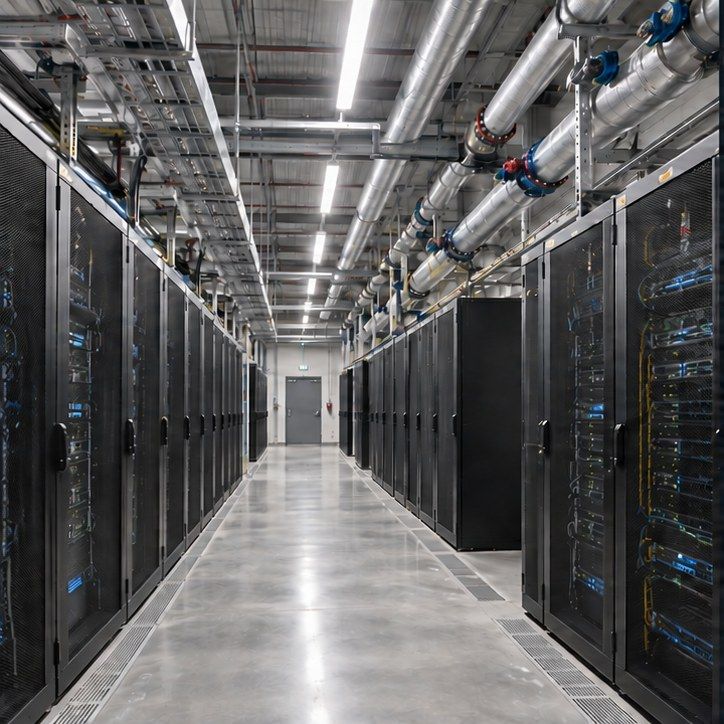
The twin on our home page uses an old warehouse as its example. Phase 1 has power but no cooling water: rows C and D enclose a contained cold aisle and start with air-cooled racks and in-row coolers. Phase 2 adds side-mounted liquid-to-air CDUs in row B. In phase 3 facility water arrives, and the liquid-cooled racks in row A connect to a facility CDU and outdoor dry coolers.
What the airflow simulation shows
- In-row supply-air, cold-aisle and hot-aisle temperatures
- Total airflow
- Temperature distribution on vertical and horizontal sections
Problems it catches early
- Hot and cold air mixing, and recirculation, caused by incomplete blanking
- Whether the number of in-row coolers matches the load
- New hot spots after an expansion
Beyond design
The same model supports operations drills: automatic leak isolation, fire-system interlock, UPS ride-through during a utility outage, and inserting a new rack into a reserved position.
The figures in the example are simulated, using a simplified airflow model.